Why Your Sports Bra Fits Differently at the End of the Day
Quick Answer: Ribcage circumference genuinely changes through the day - by 1 to 3cm for most people - driven by fluid distribution, food and drink volume, breathing depth, body temperature and, across the month, hormonal fluid retention. A bra fitted at 7am to feel snug will feel tight at 6pm. The practical answer is to fit for the middle of your day rather than either end, use the loosest hook when new, and accept that an evening session may want a different bra from a morning one.
It fitted perfectly this morning.
It is now cutting in and you have not gained anything.
Your ribcage is a different size than it was nine hours ago.
This is general information, not medical advice.
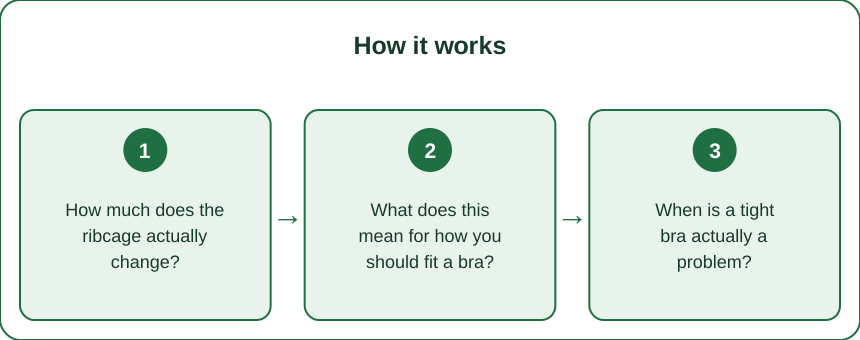
How much does the ribcage actually change?
One to three centimetres for most people, which is more than a band size.
Band sizes typically step in 5cm increments, so a 2cm daily variation is a substantial fraction of a full size. That is why the same garment can feel comfortably firm in the morning and genuinely restrictive by evening.
What drives the change:
Fluid distribution. Overnight, lying flat redistributes fluid toward the torso and face - which is why people wake up slightly puffy in the face and slimmer in the ankles. Through the day, gravity moves fluid downward toward the legs. The net effect on ribcage measurement varies, but the redistribution is real and measurable.
Food and drink volume. A full stomach expands, and the lower ribcage accommodates it. The difference between a fasted morning measurement and an after-dinner one is easily 2cm and considerably more after a large meal.
Breathing depth. Ribcage circumference differs by several centimetres between full exhale and full inhale. After exercise, breathing is deeper and the resting position of the ribcage sits slightly expanded for a period afterwards.
Temperature. In heat, surface blood vessels dilate and mild swelling occurs, particularly in the extremities but also across the torso. This is why summer evenings feel tightest of all.
Posture and muscle tone. Slumping compresses the ribcage; sitting upright expands it. After a workout involving the upper back and chest, muscle swelling adds a small amount.
And across the month: fluid retention in the days before a period commonly adds measurable circumference, along with breast tenderness and volume changes. For many people this is the largest single variable and it is entirely predictable.
What does this mean for how you should fit a bra?
Fit for the middle of your day, on the loosest hook, and test at your worst moment.
The band should be firm, not tight. A correctly fitted band does 80% of the support work and should sit level around the body without riding up at the back. You should be able to slide two fingers under it with some resistance.
Fit at a representative time. A bra fitted first thing on an empty stomach will be too small by evening. A bra fitted after dinner will be loose in the morning. Midday, a couple of hours after eating, is the most representative moment.
Buy new bras on the loosest hook. This is the standard fitting principle and it exists precisely because of this variation. As the elastic relaxes over months of wear, you tighten inward. A bra bought on the tightest hook has nowhere to go and becomes unwearable early.
Practical decisions this leads to:
- If you train in the evening, fit your training bras in the evening
- If your session is right after work and you sit all day, expect the tightest fit of the week
- Own bras in two band sizes if your monthly variation is significant - this is not indulgent, it is the same reason people own two shoe sizes for different socks
- Adjustable back closures are worth prioritising over pull-on styles for anyone with noticeable variation
On the compression versus encapsulation question, which interacts with this: compression bras press tissue against the chest wall and are more affected by ribcage change, since the whole garment is under tension. Encapsulation styles with separate cups and an adjustable band tolerate variation better and are generally the better choice for larger sizes and for anyone whose measurements move a lot.
And a check worth doing: put the bra on, raise both arms overhead, and see whether the band rides up. If it stays put, the band is doing its job. If it lifts, it is too loose - and if it lifts and also feels tight, the band is the wrong size rather than the wrong tightness.
When is a tight bra actually a problem?
When it restricts breathing, marks the skin persistently, or causes symptoms that outlast wearing it.
Some firmness is necessary. A sports bra that does not compress or encapsulate firmly does not reduce breast movement, and unrestricted movement during exercise is uncomfortable and can strain the supporting ligaments over time. Firm is the point.
Signs it has crossed into too tight:
- Restricted breathing during exercise - if you cannot take a full breath, the band is too tight and it will limit your session
- Deep marks that persist for more than 20 to 30 minutes after removal
- Numbness or tingling in the arms or hands, which suggests pressure on nerves near the shoulder
- Rib pain or soreness that continues after taking it off
- Headaches that correlate with wearing a specific bra, usually from over-tight straps loading the neck
- Skin irritation or breakdown along the band or strap line
The breathing point deserves emphasis. Exercise requires increased tidal volume, which requires the ribcage to expand. A band tight enough to limit that expansion measurably affects how the session feels and people often attribute the resulting breathlessness to fitness rather than to clothing.
Practical adjustments for a bra that is right in the morning and wrong at night:
- Loosen the straps rather than the band, since strap tension contributes to the overall squeeze
- Change to a different hook if the closure allows
- Change bras for evening sessions rather than forcing one to work for both
- Put it on later - not wearing a sports bra for the whole workday before an evening session helps more than people expect
When to get it checked: persistent rib pain, skin that breaks down along the band line, or numbness that continues after removal are worth mentioning to a healthcare professional rather than working around.
And on sizing changes generally: measurements shift with weight, training, pregnancy, hormonal contraception and the perimenopausal transition. Re-measuring twice a year is a reasonable habit, and most people are wearing a band that was correct for a body they no longer have.
Myth vs Fact: Bra Fit and Daily Change
Myth: If it fits in the morning it fits all day. Fact: Ribcage circumference varies by 1 to 3cm through the day, which is a substantial fraction of a 5cm band size step. Fitting at either extreme guarantees discomfort at the other.
Myth: A tighter band gives more support. Fact: Support comes from a correctly sized band sitting level and firm, not from maximal tightness. Beyond correct, additional tightness restricts breathing and marks the skin without adding support.
Myth: You should buy on the tightest hook so it lasts. Fact: The opposite. Buy on the loosest hook so you can tighten inward as the elastic relaxes over months. A bra bought on the tightest hook has nowhere to go and becomes unwearable early.
Myth: Feeling breathless in a sports bra means you are unfit. Fact: Exercise requires the ribcage to expand for increased tidal volume, and a band tight enough to restrict that genuinely affects the session. People routinely attribute this to fitness when it is a clothing problem.
Myth: Sizing only changes with weight. Fact: Measurements shift with training, hormonal contraception, pregnancy, the perimenopausal transition and monthly fluid retention. Re-measuring twice a year catches changes that have nothing to do with the scale.
Myth: Compression and encapsulation are interchangeable. Fact: Compression relies on whole-garment tension and is more affected by ribcage change. Encapsulation with separate cups and an adjustable band tolerates daily variation better, which matters more the larger the size.
FAQ: Sports Bra Fit Questions, Answered
How much can my ribcage really change in a day?
One to three centimetres for most people, driven by fluid redistribution, stomach volume, breathing depth, temperature and posture. Since band sizes step in five centimetre increments, that is a significant fraction of a full size.
When should I fit a new bra?
Midday, a couple of hours after eating, which is the most representative point. Fitting first thing on an empty stomach produces a bra that is too small by evening; fitting after dinner produces one that is loose in the morning.
Which hook should I buy on?
The loosest. Elastic relaxes over months of wear, so buying loose gives you room to tighten inward as it does. A bra bought on the tightest hook has no adjustment left and stops working sooner.
Is it normal for it to be tighter before my period?
Yes, and it is often the largest single variable. Hormonal fluid retention adds measurable circumference and breast tenderness and volume change alongside it. Owning a bra in a slightly larger band for those days is a practical solution rather than an indulgence.
When is a bra actually too tight?
When it restricts a full breath, leaves marks lasting more than 20 to 30 minutes, causes numbness or tingling in the arms, or produces rib pain that continues after removal. Persistent versions of any of those are worth having looked at.
Should I own more than one size?
If your measurements vary noticeably through the month, yes. It is the same logic as owning different shoes for different conditions, and forcing one band size to work across a three centimetre range means it is wrong most of the time.
TL;DR:
- Ribcage circumference varies 1 to 3cm daily from fluid, food volume, breathing, temperature and posture
- Band sizes step in 5cm, so daily variation is a large fraction of a full size
- Fit at midday, a couple of hours after eating, and always buy on the loosest hook
- Hormonal fluid retention before a period is often the largest single variable
- Encapsulation with an adjustable band tolerates variation better than compression styles
- Too tight means restricted breathing, marks lasting past 30 minutes, numbness or lingering rib pain
- Re-measure twice a year - measurements change with training, contraception and perimenopause
Owning two band sizes is not excessive. It is matching the garment to a body that moves.
See It in Motion
Seen here: UPF 50+ Short Sleeve Rashguard Swim Shirt — shop it on bubblelime.com
Keep Reading
This article is for general informational and styling purposes only. Fit, sizing, and product availability may vary.