Why Your Layers Fight You During a Workout and How to Fix It
Quick Answer: Dress for how you will feel ten minutes into the session, not how you feel walking in - which means being slightly cold at the start. Use three thin layers rather than two thick ones, with a moisture-moving base next to skin, a removable mid layer, and an outer layer that only exists for the journey. Cotton next to skin is the single most common autumn training mistake, because it holds sweat against you and stays cold.
You arrive cold, so you keep the hoodie on. Ten minutes in you are overheating, but taking it off means stopping, finding somewhere to put it, and getting cold again afterwards. So you keep it on for the whole session and finish drenched.

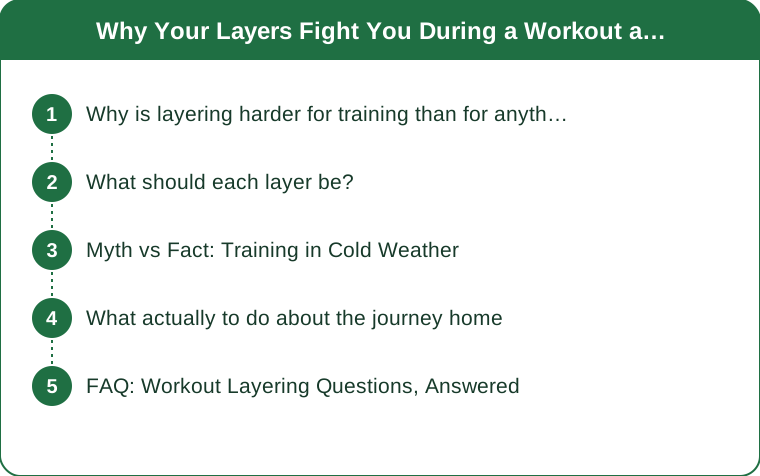
Why is layering harder for training than for anything else?
Because the temperature you need changes three times in an hour.
Three distinct phases with three different requirements. The journey in, when you are cold and not producing heat. The session, when heat production rises dramatically. And the journey home, when you are wet and cooling fast in cold air - which is the coldest you will feel all day.
Heat production during exercise is enormous. A significant proportion of the energy your muscles produce becomes heat rather than movement, and body temperature rises quickly once you are working. Clothing that felt right walking in is wrong within ten minutes.
Sweat has to go somewhere. In summer it evaporates. In a cold environment with too many layers, it saturates the layers and stays there, which means you are wet, and wet clothing conducts heat away from you far faster than dry clothing.
And you stop and start. Rest between sets, waiting for equipment, stretching at the end - all periods of low heat production in a body that is now damp. This is when people get properly cold, and it is why the after-session chill is a real phenomenon.
The core principle that solves most of it: dress to be slightly cold for the first five to ten minutes. If you are comfortable standing still before you start, you are overdressed for the session. This feels wrong and it is correct.
One exception worth naming: for genuinely cold outdoor training, warming up before going out and starting the session already warm is better than starting cold and hoping to catch up.
What should each layer be?
Three thin layers, with a defined job each.
Base layer: moisture management, next to skin. A thin synthetic or merino top. Its job is to move sweat away from skin so you are not wearing wet fabric. Cotton is the wrong choice here and it is the mistake most people make - cotton absorbs sweat and holds it, so it stays wet, stays cold, and chafes. A cotton t-shirt is fine for a warm indoor gym and a genuine problem for anything colder.
Mid layer: warmth for the start and the end, removable in seconds. A thin fleece, a lightweight long-sleeve, or a zip-up. Choose one you can remove without taking anything else off - a zip or a quarter-zip rather than something you have to pull over your head - because a layer you cannot remove easily is a layer you will keep on.
Outer layer: journey only. A jacket that comes off before the session and goes back on afterwards. It never needs to work during exercise, so it can be as warm or as waterproof as the weather requires.
Bottom half needs less than people think. Legs produce a lot of heat and are less sensitive to cold during activity. Full-length leggings are usually plenty indoors, and outdoors a single warm layer suffices for most conditions. Overdressing the legs is common and uncomfortable.
Extremities are where warmth actually matters. Hands, ears, and feet lose heat fast and contribute a lot to how cold you feel. A thin hat and gloves for outdoor training weigh nothing and change the experience completely.
And plan where the removed layer goes. This is the practical failure point. A layer that has nowhere to go stays on. A small hook, a corner of the bench, a bag placed deliberately - decide before you start.

Myth vs Fact: Training in Cold Weather
Myth: Sweating more means a better workout. Fact: Sweat is thermoregulation, not effort. Wearing extra layers to sweat more increases fluid loss and thermal strain without increasing training benefit, and in extreme cases it is genuinely dangerous. Any weight lost is water and returns with the next drink.
Myth: You should feel warm before you start. Fact: You should feel slightly cold. Body temperature rises quickly once you begin, and dressing for standing-still comfort guarantees overheating within ten minutes. Being briefly uncomfortable at the start is the correct trade.
Myth: Cotton is fine for the gym. Fact: Indoors in a warm gym for a light session, it is fine. For anything where you will sweat significantly or then go outside, cotton holds moisture against skin, stays cold, and causes chafing. It is the layer choice that most reliably makes autumn training unpleasant.
Myth: You burn more calories exercising in the cold. Fact: There is a small increase from thermoregulation, particularly if you are shivering, but it is modest and easily overstated. Cold weather does not meaningfully change the energetics of a workout.
Myth: You do not need to drink as much in cold weather. Fact: You still lose fluid through sweat and through respiration, and cold air is often dry which increases respiratory water loss. Thirst is a weaker cue in the cold, so people under-drink precisely when they should not.
Myth: Warming up matters less indoors. Fact: If you arrived cold, your tissues are cold regardless of the room’s temperature, and cold tissue is less compliant. Arriving from a cold journey means the warm-up matters more, not less.
What actually to do about the journey home
This is the part everyone under-plans, and it is the coldest and most unpleasant part of autumn training.
Change out of the damp base layer. A dry top for the journey home is the single most effective thing you can do, and it takes thirty seconds. Damp fabric in cold air conducts heat away rapidly, and you will feel cold for hours afterwards if you skip it.
Dry your hair or cover it properly. A wet head in cold air loses heat fast and is the most common reason people feel chilled all evening after training.
Put the outer layer on before you cool down, not after. Adding insulation while still warm preserves the heat you have. Adding it after you have already cooled means you are insulating a cold body.
Eat and drink something reasonably soon. Both support recovery, and a warm drink genuinely helps how you feel on a cold walk home.
Allow a few minutes indoors before stepping out. Going straight from maximal effort into cold air is a sharp transition, and a short cool-down indoors makes it far more comfortable.
And on the topic of outdoor training specifically: the wind chill on the way home, when you are damp and no longer producing much heat, is the condition to dress for. If your route home is exposed, that determines the outer layer rather than the temperature at the start of the session.
For very cold outdoor training, it is worth knowing that exercising in cold air can trigger airway narrowing in some people - a tight chest or a cough during or after cold-weather exercise is worth mentioning to a GP rather than pushing through, since it is a recognised and manageable pattern.
This is general information, not medical advice.
FAQ: Workout Layering Questions, Answered
What should I wear to work out in cold weather?
Three thin layers: a synthetic or merino base next to skin for moisture, a removable mid layer with a zip, and an outer layer that exists only for the journey. Dress to feel slightly cold standing still - by ten minutes in, you will be glad you did.
Is cotton bad for working out?
For anything where you sweat meaningfully or then go outside, yes. Cotton absorbs sweat and holds it against skin, so it stays wet, keeps you cold, and causes chafing. Indoors in a warm gym for a light session it is perfectly fine.
Should I be warm or cold when I start exercising?
Slightly cold. Body temperature rises quickly once you start working, so dressing for comfort while standing still guarantees overheating shortly afterwards. The exception is genuinely cold outdoor training, where warming up indoors first and heading out already warm works better.
Does wearing more layers help you lose weight faster?
No. Extra layers increase sweating, which is fluid loss, not fat loss - the weight returns with the next drink. It also increases thermal strain without any training benefit, and in hot conditions it is genuinely risky.
Why do I get so cold after training in autumn?
Because you are damp, no longer producing much heat, and stepping into cold air. Changing into a dry top before leaving, drying or covering your hair, and putting your outer layer on while still warm rather than after cooling down addresses nearly all of it.
TL;DR:
- Dress for ten minutes in, not for walking in - being slightly cold at the start is correct.
- Three thin layers: moisture-moving base, zip-off mid layer, outer layer for the journey only.
- Cotton next to skin is the most common autumn training mistake; it holds sweat and stays cold.
- Decide where the removed layer will go before you start, or it stays on all session.
- Change into a dry top before leaving - the journey home is the coldest part of the day.
The hoodie was never the problem. Having nowhere to put it was.
See It in Motion
Seen here: Racerback Tank Top - White — shop similar styles on bubblelime.com
Keep Reading
This article is for general informational and styling purposes only. Fit, sizing, and product availability may vary.