The Gym Wardrobe Transition Nobody Plans For
Quick Answer: Transitional gym dressing fails because you are managing two different temperature problems at once - cold on the way there and hot once you are training. One outfit cannot solve both, but a three-piece system can: a technical base you train in, a midlayer you remove after warming up, and an outer layer that never enters the workout. Buy the midlayer properly and the rest can be what you already own.
The most common error is training in the layer you travelled in.
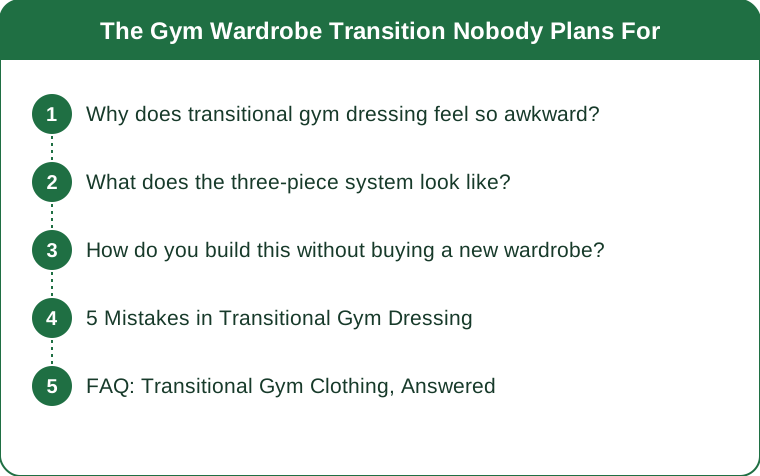
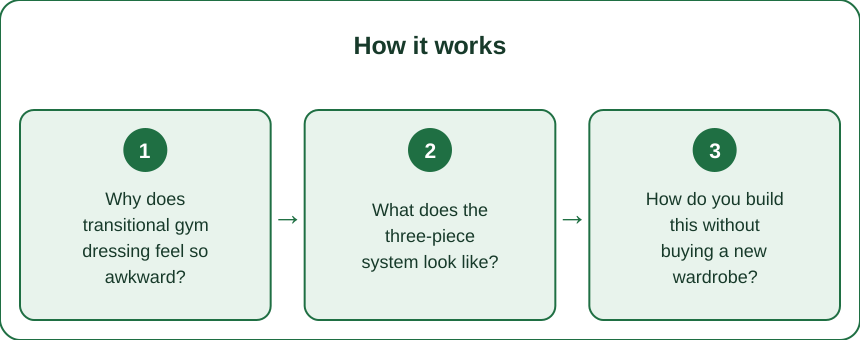
Why does transitional gym dressing feel so awkward?
Because you are solving two opposite problems within twenty minutes of each other.
Problem one: the journey. At 10C, walking or cycling to the gym in summer kit is genuinely unpleasant, and arriving cold means a longer warm-up and worse early sets.
Problem two: the session. Your body produces significant heat during exercise, and your effective temperature is far higher than the room. A layer that was right for the walk becomes wrong within ten minutes.
Why one outfit cannot solve both. The temperature range you are covering is roughly 15 to 20C between the walk and the middle of a session. No single garment covers that, which is why the answer has to be a system rather than a purchase.
The failure modes people fall into:
- Dressing for the workout and freezing on the way - the most common, and it costs you a proper warm-up
- Dressing for the journey and overheating in the session, then training in a soaked layer
- Bringing a change of clothes and never using it, because changing twice is friction
- Training in a cotton hoodie, which absorbs sweat, gets heavy, and stays cold
The bit people underestimate: cooling down. Leaving a warm gym after a hot shower into cold air is when you actually get cold. Body temperature is dropping, hair may be damp, and clothes are the only variable. More people get properly cold leaving the gym than arriving.
The specific autumn problem indoors. Gyms are heated inconsistently in the shoulder season. Some are still on summer settings and cold; some have gone straight to winter heating and are too warm. You cannot predict it, which is another argument for layers you can remove.
What does the three-piece system look like?
One thing you train in, one you remove, one that never comes off the hanger during the session.
Layer 1: the training base.
- A technical short-sleeve or long-sleeve top that wicks properly. Not cotton - once soaked it stays wet, gets heavy, and chills you the moment you stop
- Fitted rather than loose, since a wicking fabric needs skin contact to work
- Long sleeves are the transitional advantage - enough for a cold gym, and you can push them up
- This is what you train in from the first set to the last
Layer 2: the removable midlayer.
- A light fleece, a quarter zip, or a technical hoodie
- Worn through the warm-up and removed around minute 10. This is the layer doing the actual work
- A zip is better than a pullover, because you can vent without removing
- Must fit over the base without restricting movement - check the overhead reach and a squat before buying
- This is the piece worth spending on, since it is the one that makes the system function
Layer 3: the outer.
- A windproof shell or an insulated jacket, depending on the temperature
- Never worn during the session. This lives in a locker or on a bench
- Wind resistance matters more than thickness for the journey - a thin windproof beats a thick fleece at 10C
- Something that packs down, since it has to go in a bag or locker
Bottoms, which are simpler:
- Full-length leggings become the default once mornings drop below about 15C
- A thicker weight than summer leggings - brushed or fleece-lined for the coldest journeys
- Joggers over shorts is the alternative for anyone who prefers to train in shorts
- Check opacity in the fitting position. Thicker autumn fabrics are usually better here, but check regardless
The accessories that punch above their weight:
- A beanie for the journey, which is the highest warmth-per-gram item you can carry
- Proper socks, since wet feet on the walk in are miserable and persist all session
- Light gloves, particularly for cycling
- A change of top for the journey home. Travelling home in the top you trained in is the single most common way to get cold after a session
How do you build this without buying a new wardrobe?
Most of it is in the drawer already; the honest gap is usually one piece.
The audit, which takes ten minutes:
- Lay out everything you own for training
- Sort into: train in, travel in, and never wear
- The never-wear pile tells you something - usually about fit or fabric, and it is worth knowing why before buying again
- Identify which of the three layers you are missing. For most people it is the midlayer
What to actually spend on, in order:
- The midlayer, which is the functional heart of the system and the piece most people lack
- A good pair of full-length leggings in a heavier weight
- Technical socks, cheap and disproportionately useful
- A windproof shell, if you do not already own one for general use
What not to spend on:
- Matching sets for the sake of it. They are pleasant and they do not solve the temperature problem
- Heavily insulated jackets for gym use, which are overkill for a 15-minute journey
- Multiple midlayers. One good one is enough - it gets washed
Repurposing from outside the gym drawer:
- A general-purpose fleece or quarter zip works perfectly well as a midlayer
- A hiking or running windproof doubles as the outer layer
- Merino base layers from outdoor kit are excellent training bases
- There is no reason gym clothes must be bought as gym clothes, and the technical outdoor equivalents are frequently better made
Laundry logistics, which is the real constraint. The transitional system means more items per session, which means more washing.
- Three or four complete sets is the practical minimum for training three or four times a week
- The midlayer needs washing less often than the base, since it comes off before the hardest sweating
- Wash technical fabrics separately, without softener, at the temperature the label allows
- Air dry rather than tumble drying, which extends the life of elastane considerably
On when to make the switch. The trigger is the morning temperature, not the date. Once mornings are consistently below about 15C, the system is worth running. In most temperate regions that is late September to early October, and it varies by a fortnight in either direction year to year.
5 Mistakes in Transitional Gym Dressing
1. Training in the layer you travelled in. It gets soaked, it stays wet, and you then wear it home. The travel layer and the training layer are different garments - that is the entire principle.
2. Wearing cotton anywhere in the system. Cotton absorbs sweat, gets heavy, and stays cold. A cotton hoodie is the single worst transitional gym garment and also the most commonly worn one.
3. Buying a heavy jacket instead of a midlayer. The jacket solves the journey and does nothing for the session. The midlayer is the piece that covers the range, and it is the one most wardrobes are missing.
4. Not bringing a dry top for the journey home. After a shower, in cold air, with damp hair, wearing the top you trained in. This is where people actually get cold, not on the way there.
5. Waiting for a date rather than a temperature. People switch wardrobes on the first of October regardless of the weather. The trigger is mornings consistently under about 15C, which varies by a fortnight year to year.
Four of these cost you comfort. The third costs you money on the wrong item, which is why the midlayer is worth naming specifically.
FAQ: Transitional Gym Clothing, Answered
What is the one piece most people are missing?
A removable midlayer - a light fleece, quarter zip, or technical hoodie worn through the warm-up and taken off around minute ten. Most wardrobes have training kit and a coat, with nothing in between.
Can I just train in a hoodie?
Not a cotton one. It absorbs sweat, gets heavy, and stays cold once you stop. A technical hoodie you remove after warming up is fine; training in a soaked cotton one is the classic autumn mistake.
When should I switch to full-length leggings?
When morning temperatures are consistently below about 15C. Use the temperature rather than the date - the right week varies by a fortnight from year to year.
How many sets of gym kit do I need for this system?
Three or four complete sets if you train three or four times a week. The midlayer needs washing less often than the base, since it comes off before the hardest sweating.
Do I need gym-specific clothing for this?
No. Outdoor and hiking equivalents - fleeces, merino base layers, windproof shells - work as well or better and are often built to a higher standard. The functional requirements are identical.
Why do I get colder leaving the gym than arriving?
Because your body temperature is falling after exercise, your hair may be damp, and you are often still in the top you trained in. Bring a dry top and a proper outer layer for the journey home.
TL;DR:
- Transitional gym dressing solves two opposite problems, so it needs a system rather than an outfit
- Three layers: a technical base you train in, a midlayer you remove at minute ten, an outer that never joins the session
- The midlayer is the missing piece in most wardrobes and the one worth spending on
- Nothing cotton anywhere - it absorbs, stays wet, and chills you the moment you stop
- Bring a dry top for the journey home; that is when people actually get cold
Most of this is already in your drawers, including the outdoor kit you never thought of as gym clothes. The audit takes ten minutes and usually reveals a single genuine gap.
See It in Motion
Seen here: High Waist Yoga Leggings with Side Pockets — shop it on bubblelime.com
Keep Reading
This article is for general informational and styling purposes only. Fit, sizing, and product availability may vary.