How to Tell When a Sports Bra Has Lost Its Support
Quick Answer: A sports bra is finished when the band no longer holds firm on the loosest hook, when it rides up during a session, or when you notice more movement in the same activity you have always done. Elastic degrades from heat, sweat, and stretch cycles regardless of how the fabric looks, so appearance is a poor guide.
Most bras worn regularly need replacing somewhere between six and twelve months, and the band tells you before anything else does.
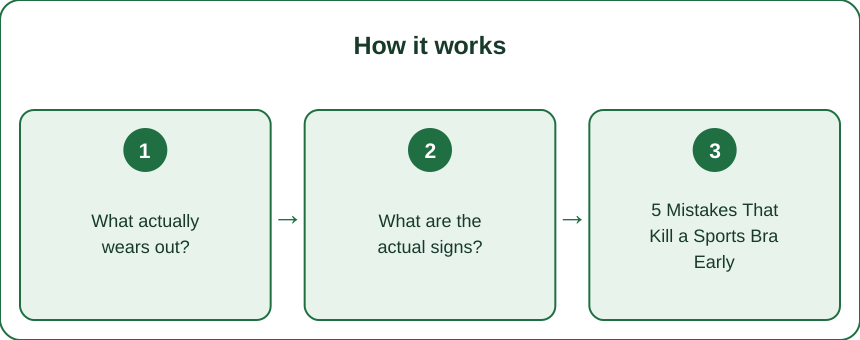
What actually wears out?
The elastic, not the fabric - which is why a bra can look almost new and support nothing.
Sports bras rely on elastane, spandex, or similar elastomeric fibers blended into the fabric and concentrated in the band and straps. These fibers work by stretching and recovering. Over time, recovery becomes incomplete - the fiber returns to slightly longer than its original length each cycle, and those small losses accumulate.
What accelerates it:
- Heat. The biggest single factor. Hot water washing, tumble dryers, and hot car interiors all degrade elastane substantially. A bra dried on high heat regularly will lose support in a fraction of the time.
- Sweat. Salt and body oils break down elastic fibers, and a bra worn and not washed promptly gets prolonged exposure.
- Stretch cycles. Every wear is a cycle. High-impact use means more force per cycle.
- Chlorine and UV, for anyone swimming or training outdoors regularly.
- Detergent residue and fabric softener. Softener in particular coats fibers and degrades elasticity - it should never go near activewear.
Meanwhile the outer fabric - typically polyester or nylon - is far more durable and shows almost no wear. So the visible condition of a bra reflects the part that lasts, not the part that matters. This is the core of the problem: you are judging by the wrong material.
A useful mental model: the band is a spring, and springs get tired. A tired spring still looks like a spring.
What are the actual signs?
Five, in rough order of how early they appear.
1. The band no longer feels firm on the loosest hook. For a hook-and-eye bra, this is the clearest test available. New bras should fit on the loosest setting, giving you tighter settings to move to as the elastic relaxes. When you are on the tightest hook and it still feels loose, the bra is finished. For pull-on styles with no hooks, the equivalent test is whether you can pull the band away from your body more than a couple of inches.
2. It rides up during a session. A band that migrates upward is not holding. Since the band provides the large majority of a bra’s support - considerably more than the straps - a riding band means most of the support is gone regardless of how the cups feel.
3. More movement in the same activity. The most direct sign and the easiest to dismiss, because it happens gradually. If a run that used to feel controlled now does not, and your body and the activity have not changed, the bra has.
4. You have tightened the straps to compensate. A common and telling adaptation. Straps carry a minority of the load, so tightening them to make up for a loose band shifts force onto your shoulders - which is why shoulder and neck discomfort often appears alongside a worn-out bra.
5. Visible signs at the band and straps. Rippling or waviness in the band elastic, straps that have gone soft and stringy, or a band that no longer lies flat. By this point the bra has usually been past it for a while.
The one thing not on this list: the cups looking worn or pilled. Cosmetic wear happens on a different timeline and tells you nothing about support.
5 Mistakes That Kill a Sports Bra Early
-
The tumble dryer. The single most damaging habit. Heat is what degrades elastane fastest, and a dryer applies it repeatedly for extended periods. A bra that would last a year on a drying rack may lose meaningful support in a few months on high heat. Air dry, always - and away from a radiator, which is the same mistake in a different location.
-
Fabric softener. It works by coating fibers with a lubricating film. On activewear that film blocks moisture-wicking and degrades elastic, and it builds up over successive washes. It also traps odor compounds, which is why softener-washed activewear often smells worse rather than better. Skip it entirely.
-
Leaving it balled up in the bag. Sweat left in contact with elastic for hours accelerates breakdown, and a damp bra in a warm bag is also a bacterial problem. Take it out when you get home, always, even if you cannot wash it immediately.
-
Wearing the same bra every session. Elastic recovers with rest - fibers that have been stretched need time to return toward their original length. Rotating between two or three bras genuinely extends the life of all of them, and the effect is larger than most people expect. Two bras rotated typically last more than twice as long as one worn continuously.
-
Washing hot. Cold or lukewarm water cleans activewear perfectly well, since the soils involved are body oils and salts rather than baked-on grime. Hot water offers no cleaning benefit here and costs you elasticity. Turn the bra inside out, wash cool on a gentle cycle in a mesh bag, and skip the softener.
The fourth one surprises most people, because a spare sports bra feels like an indulgence rather than an economy. It is the economy.
How long should one actually last?
Six to twelve months for a bra in regular rotation, with a wide range depending on use.
The more accurate way to think about it is wear cycles rather than calendar time. A common guideline is somewhere around 30 to 40 washes, which maps to different timescales depending on how often you train:
- Five sessions a week, one bra - a few months
- Three sessions a week, rotating three bras - potentially well over a year each
- High-impact running versus low-impact yoga - the running bra endures much greater force per wear and will finish sooner
Factors that shorten it: high-impact activity, heavy sweating, larger cup sizes where the elastic works harder, hot climates, and any of the five mistakes above.
What to do about the cost, since replacing bras regularly is genuinely expensive:
- Buy fewer, better, and rotate them. Three bras rotated last far longer in total than three bought and worn out sequentially.
- Match the bra to the activity. Using a high-impact bra for yoga wears out an expensive garment on a job a cheaper one could do.
- Retire rather than discard. A bra that no longer supports running is often still fine for walking, weights, or lounging. Demote it rather than binning it.
- Note the purchase date. Writing the month on the care label in laundry pen sounds excessive and is genuinely useful, because the gradual nature of the decline is exactly what makes it hard to judge.
And the point worth stating plainly: breast tissue is supported by skin and connective tissue, and repeated unsupported movement during high-impact exercise causes strain and discomfort. A bra that has stopped doing its job is not a cosmetic issue. If you are noticing more bounce, that is the signal, and it is worth acting on rather than waiting for the band to visibly fail.
FAQ: Sports Bra Lifespan Questions, Answered
Can I do anything to restore the elastic?
No. Once elastane has lost recovery, it does not come back - there is no wash, soak, or treatment that restores it. Advice suggesting hot water or dryer heat will shrink a bra back is actively harmful, since heat is what damaged it. What you can do is prevent further loss on the bras you still have.
Is it the same for encapsulation and compression bras?
Both rely on elastic and both wear out, but the failure looks different. A compression bra loses its firmness gradually and quietly. An encapsulation bra with separate cups often shows it more clearly through the band and underwire fit. Encapsulation styles frequently last slightly longer because less of the support depends on overall fabric tension.
Does size change mean the bra failed?
Not necessarily - body changes, weight changes, and cycle-related changes all affect fit, and many people find their fit varies within a single month. The distinguishing question is whether the band feels loose everywhere or the cups feel wrong. A loose band on the tightest hook is bra failure; cups that fit differently week to week is usually your body.
Is hand washing worth it?
Slightly better than a machine, but the bigger wins are cold water, no softener, and air drying - all of which you can do in a machine. A gentle cycle in a mesh bag at low temperature is nearly as good as hand washing and far more likely to actually happen.
TL;DR:
- The elastic wears out while the fabric looks fine, so appearance is the wrong thing to judge by.
- The band carries most of the support - if it is loose on the tightest hook or rides up during a session, the bra is done.
- Tightening the straps to compensate is a telltale sign, and it shifts load onto your shoulders.
- Heat is the biggest killer: no tumble dryer, no radiator, cold washes, and never fabric softener.
- Rotating two or three bras extends the life of all of them by more than the arithmetic suggests.
Check which hook you are on. If it is the tightest one and the band still moves, replace it.
See It in Motion
Seen here: UPF 50+ Racerback Yoga Tank Top — shop it on bubblelime.com
Keep Reading
This article is for general informational and styling purposes only. Fit, sizing, and product availability may vary.